The Logistic Error of the Giant Breed
People see a giant dog on the internet and immediately want one. Better yet, they get fed a few high octane clips in their feed of a massive animal ripping apart a simulated predator or facing down a wolf, and the immediate reaction is, “I need that.”
The reality is you don’t. Most people don’t. Falling for that short video loop is a severe logistical error, and it happens with this breed and so many other’s.
What are we actually talking about here? The Turkish Kangal, historically known as the Kangal Shepherd Dog, Kangal Çoban Köpeği, or the Karabash. This is a legendary landrace asset forged on the brutal, sweeping landscapes of Central Anatolia, specifically climbing to prominence in the Sivas Province of Turkey, getting their namesake, “Kangal” from the town or district of Kangal. They were not engineered to be decorative apartment pets or casual suburban companions. They were bred to survive extreme weather and autonomously defend livestock flocks against active apex predators like wolves and bears. They are independent contractors who require a dedicated perimeter to patrol.
Because of that ancient genetic blueprint, their DNA demands a secure perimeter. This historical context is exactly why most modern households fail. To understand why you probably shouldn’t own one, you have to understand what they were built to do: they conserve energy with absolute stillness until the exact millisecond extreme physical intervention is required. They process the world through a permanent lens of threat assessment, operating on an entirely different frequency than a standard domestic dog.
Knowing that formidable heritage, can a modern Kangal successfully be integrated into a family household? I do believe that with a strict management plan, appropriate boundaries set, early training and a strong bond, that it can be done.
Our intention with this blueprint is to prove that a giant breed livestock guardian dog as formidable as the Kangal can successfully operate as an adventuring partner, a livestock protector, and a well-mannered house dog simultaneously (This last one is touch and go, to be frank). We are taking the public along for the ride to see the failures, the successes, and whether balancing these three distinct roles is actually possible in the real world.
Let me be completely clear from the outset: I am not writing this to convince you that you can simply buy a Kangal and easily manage it. I am writing this to show that with intense hard work, daily dedication, and actual blood, sweat, and tears, there is a chance that you can mold this breed into a functional partner. There is absolutely no guarantee, but you are welcome to subscribe and stick around for the process and the results.
Quick Navigation
- Jump to The Turkish Kangal Indoor Asset Baseline
- Jump to The Perimeter & Off-Leash Reality
- Jump to The Turkish Kangal Breed Signatures
- Jump to The Genetic Health & Bloat Profile
- Jump to Crucial Clinical & Surgical Protocols
- Jump to Pack Hierarchy & Yard Rotation Logics
Her Royal Highness and Her Subjects
Astraea Nyx is an inside dog. She is not a lawn ornament, and she does not live in a kennel run. There is a common misconception in the dog world that a primitive livestock guardian breed must be relegated to a barn or a pasture 24 hours a day to preserve their working instincts. We are actively dismantling that myth, or at least hoping to.
Living inside the home allows for a deeper operational bond and a constant assessment of the household environment. She learns the people and their nuances. By sharing our living space, Nyx learns the exact baseline of our daily routine. A giant guardian breed does not need to be isolated to understand territory. She processes the normal sounds of the household, from the specific idle of our pickup truck to the distinct pacing of family members moving through the rooms.
Because she has mapped out normal so thoroughly, she identifies environmental anomalies immediately:
- A strange footprint in the mud
- An unfamiliar vehicle turning around down the road
- A bear getting into our garbage
- A shifting wind carrying an unknown scent past the porch
Any of these anomalies triggers an immediate, quiet alert. This is not casual companionship. It is a continuous threat assessment conducted by a dog that has the potential to weigh more than most adult humans.
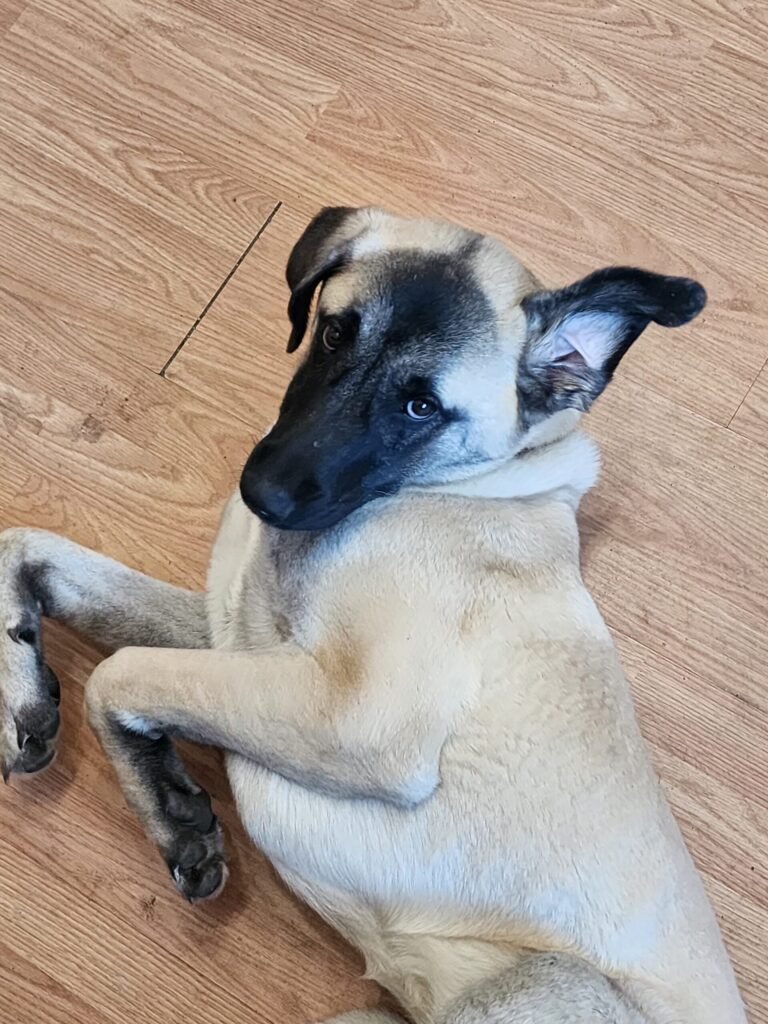
Integrating a formidable guardian into the house requires strict management. It means teaching absolute boundary control at the doorways, clear impulse control around family chaos, and zero tolerance for adolescent boundary testing inside the home. You are letting peace through superior firepower sleep on your rug. That privilege is entirely earned through consistent leadership, showing affection, and mutual respect. And let’s be completely honest, don’t forget the food.
The Perimeter Reality
Our homestead consists of a little over an acre of property in Northeast Pennsylvania. However, our physical boundary line marks the immediate beginning of over 1500 acres of open Federal land. We do not manage the forest. We manage the dog.
This specific environment requires a highly disciplined, long term approach to perimeter training and off leash reliability. There is no physical fence to do the work for us. If a standard suburban dog slips past a handler, they end up in a neighbor’s flower bed. If an autonomous guardian breed ignores a boundary line on this property, they do not just cross a line. They vanish into thousands of acres of dense, unimproved wilderness. The stakes are completely different.
The internet is full of generic advice stating that you can never trust a livestock guardian breed off leash under any circumstances. The common claim is that their roaming instinct will inevitably cause them to expand their territory for miles. While that instinct is deeply embedded in their DNA, our goal is to prove that systematic, daily boundary work can channel that drive.
We map the perimeter through endless, boring repetition on a lead. We start with heavy line work on a leash, move slowly to long lines, and eventually transition to off leash tracking. The dog must learn that the invisible boundary of the property is a hard operational wall.
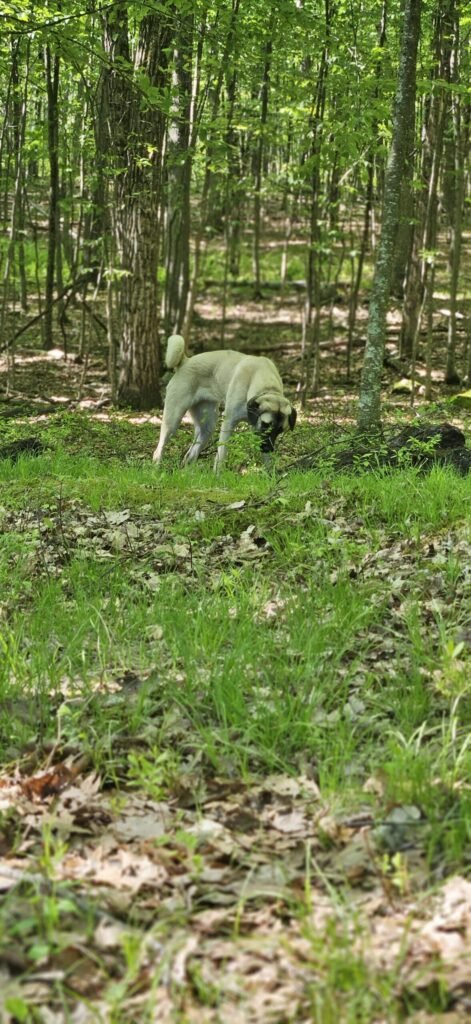
This training is a grueling process that takes months of consistency, patience, and a massive investment of personal time. There are no shortcuts when you are training a triple digit independent contractor to respect an imaginary line next to a massive forest backdrop.
There is a chance that we will fail, and the internet will scream that they were right. However, I do believe with the right amount of guidance, training, and bonding, we have a pretty good chance to prove them wrong.
The Exercise Myth
We do not take marathon walks. The Turkish Kangal is a low energy, high vigilance breed. Due to professional constraints, many of our daily yard rotations are brief and are split between being on a leash or off-leash.
On-leash rotations allow me to physically show her the boundaries as we walk them. Off-leash rotations allow her the freedom to move while I handle corrections vocally and with an e-collar. You can check out our full review of the Dogtra 1900X system and exactly how we use it on a double-coated breed right here.
There is a common assumption that a massive, triple digit working dog requires five miles of intense daily cardio or an open field to sprint in for hours just to remain stable inside the home. This is completely false.
They do not need a gym membership. They need a sense of purpose. A Kangal is built to conserve energy until the exact moment energy is required to defend an asset.
When you live with a mixed pack, you see this contrast in real time. Our Belgian Malinois operates like a never ending bottle of energy drinks, constantly demanding physical output and mental puzzle solving to keep their engine from overheating. The Kangal operates on an entirely different frequency.
A ten to twenty minute slow patrol of the property line satisfies their brain far more than miles of mindless running. Even the ability to sniff around the property and understand what is moving through at night helps, as she works through the surroundings and corresponding smells. They are processing data, checking air scents, and verifying that the perimeter baseline has not changed. Mental tracking and impulse control work are far more draining for this breed than pure physical exertion.
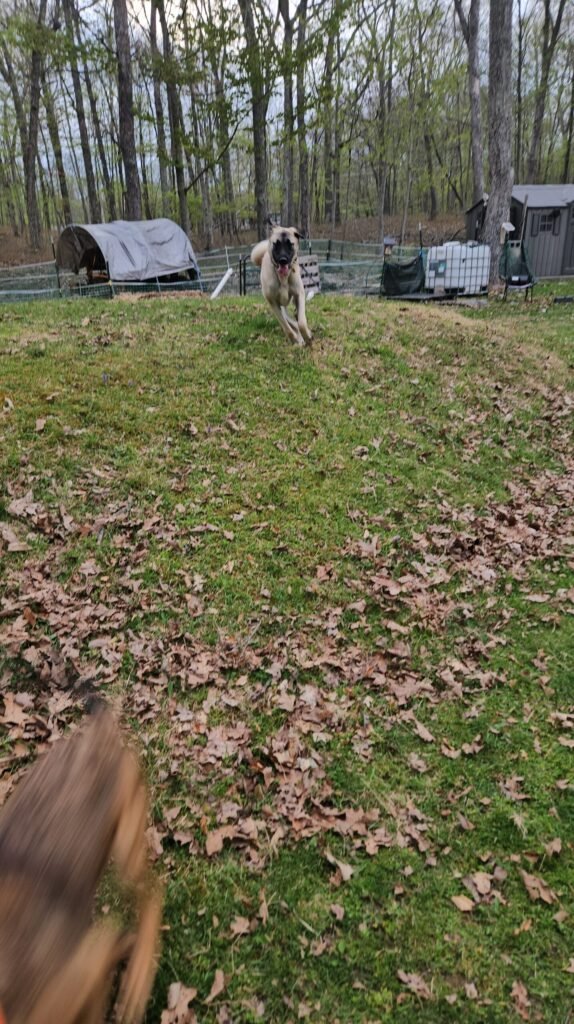
Homestead Reality: Just this morning, Nyx has been out four times since 5:30 AM. Twice to use the bathroom, once to charge me and playfully bite me to encourage playing with her, and once to drag a tree out of the woods for the purpose of me trying to throw it to play an odd version of fetch. That is how they use their energy. It is purposeful, intense, and on their time.
Providing puzzle toys that require the dog to think and solve a problem independently also does wonders for their mental health. When our Kangal encounters a challenge with a puzzle, she often whines when things do not immediately go her way. We do not step in to help her. She has to work through the frustration and solve the problem herself.
Managing a giant breed on a working schedule means focusing on efficiency. If you are trying to tire out a Kangal by running them into the ground, you are using the wrong tool for the job.
Livestock Integration and Probationary Training
Our homestead currently includes four goats and eight chickens. Livestock integration is the most critical phase of modern guardian management, and it is the exact area where most novice owners fail. The internet is flooded with idealized images of guardian puppies peacefully sleeping alongside newborn lambs, creating a false impression that the protective instinct is completely automatic from day one. The reality is a tedious, long term grind.
Currently, Nyx is in a strict probationary training phase with our livestock. We are slowly conditioning her to view the goats as assets to protect rather than large playmates to roughhouse.
The current operational reality is that Nyx absolutely loves the goats. However, because she is only ten months old, her maturity is still a long way off. Due to her age, she sees them entirely as playmates rather than creatures she is systematically supposed to protect. The goats, completely unimpressed by a triple digit puppy, rely on headbutting her as a defense mechanism. Nyx remains completely undeterred by the rejection.
This layout gets complicated on a smaller homestead with exactly four goats. An adolescent dog attempting to engage in full contact puppy play can easily injure small stock. Movement triggers drive.
Homestead Reality: Just recently, she playfully chased them around the enclosure and managed to run into the electric fence. The resulting reaction was an incredible display of unedited canine drama. The goats may have snickered, but she learned a very sudden lesson about boundaries. However, the desire to play with her friends is still there.
We manage this integration through slow, supervised exposure. Nyx does not have free, unsupervised access to the stock pens. Every single interaction is monitored on a lead or through a secure fence line to reinforce absolute impulse control. She must learn to remain calm, neutral, and observant in their presence, even when the goats choose to run or test boundaries. It is a slow marathon of patience where a single mistake can cost you an asset.
Turkish Kangal Breed Signatures and Physical Standards
The Turkish Kangal Karabaş (The Black Head)
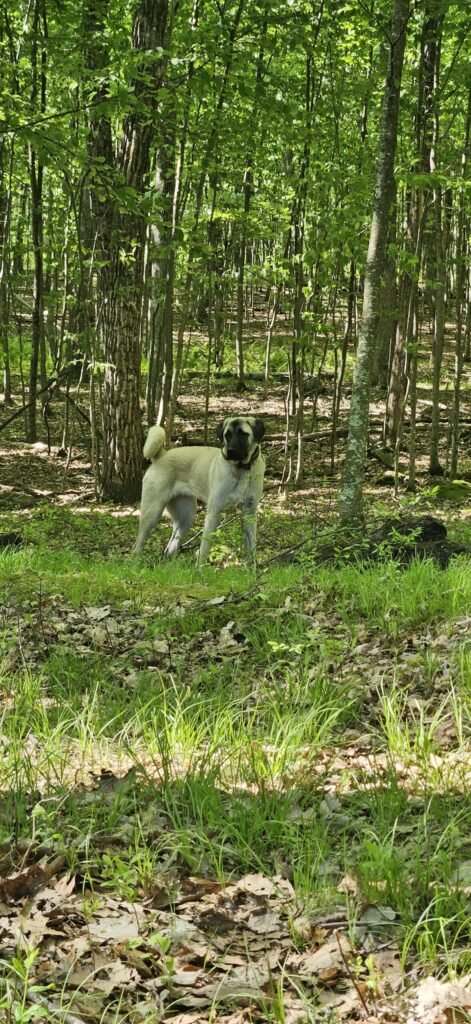
The signature solid black mask and ears are non-negotiable features of a true Turkish Kangal. The term Karabaş literally translates from Turkish as black head. This dark masking must cover the muzzle and completely envelop the ears, creating a stark visual contrast against the pale fawn coat.
This is not a cosmetic accident. In the Sivas region, that dark mask serves a specific psychological purpose. It defines the dog’s presence from a distance, signaling a formidable guardian to any apex predators moving near the flock.
When people see a dog labeled as a Kangal that features large white patches on the face, a fully white head, or a brindled coat, they are looking at a mixed animal. A purebred Kangal is never spotted or multi-colored. White markings are strictly limited to small, isolated patches on the toes or the chest.
Homestead Observation: At ten months old, Nyx’s mask is completely locked in. It anchors her expression, giving her that classic, serious guardian look even when she is doing something completely ridiculous like trying to play fetch with a fallen log. The black head is the ultimate hallmark of the breed legacy.
The Turkish Kangal Simit (The Double Curled Tail)
The carry of the tail is the most active indicator of a Kangal’s current operational status. The term simit refers to a traditional circular Turkish sesame bread, describing the tight, double curled ring the dog forms over its back when alert, patrolling, or evaluating a potential anomaly.
This carriage is a direct signal of confidence and high vigilance. When Nyx is moving along the perimeter line or monitoring the wood line, the tail is up and tightly coiled. It functions as a visual flag within the pack hierarchy and to anything watching from the brush.
Conversely, when the dog is completely off duty, relaxed inside the house, or sleeping on the rug, the tail drops into a low, loose carriage with a slight upward hook at the tip. Novice owners often misunderstand this physical signature, assuming a dropped tail means the dog is timid or sick. It simply means the handler is not paying for active threat assessments at that exact moment. It is energy conservation in practice.
Homestead Observation: At ten months old, Nyx has developed a textbook simit curl. However, because she is still an adolescent, the tail occasionally functions as a barometer for her dramatic side, like when it uncoils slightly in utter confusion after a headbutt from a goat or a brief encounter with the electric fence.
The Turkish Kangal Sürmeli (The Kohl Eyeliner)
The Kangal features distinct almond-shaped eyes with dark, kohl-like outlines that make the dog look as if she is wearing heavy eyeliner. This traditional Turkish term refers to the ancient practice of using kohl for eye protection and aesthetics.
This shading serves a highly functional purpose on the open plateau of the Sivas region. The dark pigmentation minimizes glare from the intense sun, protecting the eyes and allowing the dog to maintain a piercing, high vigilance gaze during environmental assessments. It is a natural adaptation for an animal designed to scan wide distances for hours at a time.
Homestead Observation: On our homestead, this physical standard gives Nyx a perpetually intense, serious expression. She looks like a stoic, ancient guardian even when she is exhibiting pure ten month old adolescent chaos, such as charging across the yard to demand a full contact game of fetch with a tree branch. The heavy liner frames her eyes and accentuates her focus when she identifies a change in the property baseline, making her visual alerts unmistakable.
Functional Double Dewclaws
The presence of functional rear double dewclaws located on a distinct extra toe is a critical structural norm for the breed. Novice owners who are only familiar with standard western breeds often look at these extra rear claws and mistake them for a genetic deformity that requires surgical removal. With a purebred Turkish Kangal, removing them is a major structural mistake.
These are not loose pieces of skin. They are fully articulated digits attached directly to the bony structure of the leg. Historically, this adaptation provided a wider physical surface area and superior stabilization, allowing the guardian to navigate the rugged, uneven, and rocky terrain of the Anatolian plateau with specialized torque. It acts as a natural stabilizer when a triple digit dog needs to make sudden, high speed turns while pursuing a threat or moving across loose stone.
Homestead Observation: On our homestead, you see the mechanical advantage of this feature during daily yard rotations. When Nyx throws her weight into a sudden turn on wet grass or thawing spring mud, those rear dewclaws act like built in cleats. They dig into the ground, preventing her rear end from sliding out and allowing her to maintain traction at full tilt. It is an ancient piece of off road engineering that keeps a massive, heavy asset functionally agile.
The Double Coat
A true Turkish Kangal carries a distinct double coat consisting of a dense, insulating undercoat and a harsh, weather resistant outer coat. This specific coat structure evolved to protect the dog against the brutal environmental extremes of the Anatolian plateau, where temperatures swing from scorching summer heat to sub zero winter blizzards.
This dual layer system works as a natural climate control asset. The thick undercoat traps air to keep the dog warm in the winter, while the outer guard hairs repel moisture, mud, and wind. In the summer, that same undercoat sheds out significantly, allowing air to circulate close to the skin while the outer coat shields the dog from direct sun exposure and bites from insects or brush.
Homestead Observation: On our homestead in NE PA, this coat means Nyx is completely unfazed by freezing rain, deep snow, or sudden spring thaws. The trade off for this specialized weatherproofing is the seasonal undercoat blow. Twice a year, a giant breed double coat sheds out completely over the course of several weeks. This is not casual shedding. It is a massive, high volume displacement of loose fur that requires daily manual maintenance with a grooming rake to prevent matting. If you choose to share your living space with this breed, you are choosing to accept that fine undercoat fur becomes a temporary design feature on your rugs, your clothing, and the interior of your truck. It is the literal tax you pay for an authentic all weather guardian.
Lifespan Reality
A common piece of misinformation circulating online is that the Turkish Kangal routinely reaches fifteen years of age. While primitive working dogs in rural Turkey occasionally achieve these numbers, a realistic lifespan baseline for a giant breed in a modern western environment is ten to thirteen years. Massive frames carry massive weight, and the clock ticks faster for a triple digit dog.
Managing a Turkish Kangal for longevity requires an active commitment from day one. It means rejecting the urge to power feed your puppy for maximum weight benchmarks. Extra weight on a fast growing skeleton is a direct investment in early arthritis and joint failure. Keeping your dog lean during their first two years is the single most effective variable you can control to extend their life.
You do not own a breed like this for decades of casual companionship. You own them for a finite, intense chapter of loyalty. Because that window is structurally shorter than it would be for a standard domestic breed, you are forced to manage their physical conditioning with absolute precision from day one to ensure they make it to those senior years safely.
Kangal Health Profile and Genetic Baseline
As a primitive landrace breed, the Turkish Kangal is remarkably resilient compared to many modern western giant breeds. They have evolved to be functional, working assets capable of enduring harsh environmental conditions without a reliance on intensive veterinary intervention. However, their massive skeletal frame and rapid juvenile growth rate introduce specific physical vulnerabilities that require deliberate management from day one.
The primary orthopedic concern for any giant breed is hip and elbow dysplasia. While genetics lay the baseline for joint structure, environmental factors dictate whether those genetics turn into early joint failure. This reality is why our structural management plan focuses heavily on bone density, steady muscle growth, and joint care. Our daily routine prioritizes the proper diet, precise phosphorus to calcium ratios, EPA and DHA for proper brain development, and targeted chondroitin and glucosamine for structural joint support. Believe it or not, there is a massive amount of actual science that goes into managing a giant breed dog successfully.
Beyond joint health, deep chested breeds carry an inherent risk for Gastric Dilatation Volvulus, commonly known as bloat. Managing this risk means:
- Enforcing strict rest periods before and after feeding
- Preventing high volume water consumption immediately after physical exertion
- Understanding that their digestive systems operate on a completely different timeline than smaller domestic dogs
Homestead Reality: On our homestead, we enforce a strict one hour rest period after every single meal. That means no roughhousing and no nonsense. Nyx does not always see eye to eye with us on this restriction, but as the handler, you have to remain completely firm. We understand that one hour does not fully digest the food, but that down time allows the stomach contents to settle safely. We apply the same rigid standard after high intensity play or yard work, where her water consumption is strictly limited and metered to prevent the sudden gulping that triggers a medical crisis.
During a spay, many veterinarians will offer a prophylactic gastropexy, which is a surgery to tack the stomach to the abdominal cavity wall. It is important to understand the mechanics of this procedure. Tacking the stomach does not prevent bloat from occurring, but it physically prevents the stomach from twisting if a bloat event happens. The twist is what cuts off blood supply and makes the condition rapidly fatal. Deciding whether to opt for this structural alteration comes down to a risk assessment based on your individual dog’s lifestyle, lineage, chest depth, and your access to 24 hour emergency veterinary care.
From a personal perspective, if and when Nyx is spayed, I will probably opt into the surgery. I know it does not solve the underlying bloat issue, but an accumulation of gas can be rectified at an emergency clinic much easier than a twisted stomach. I highly suggest you do your own thorough research and weigh the pros and cons for your own animal, because I am certainly not going to make that decision for you.
Clinical Vigilance and Surgical Protocol
Losing our first Kangal, Freyja, at just four years old was a brutal lesson in how high the stakes truly are when navigating medical care with this breed. We lost her following a routine spay. Our objective in waiting until she was four was to ensure her growth plates had fully closed and her skeletal development was complete. What we learned through that devastating experience is that most standard suburban veterinarians are completely unaware of the specific clinical research surrounding primitive giant breeds.
The clinical reality is that Kangals have a vastly different metabolic rate, cardiovascular volume, and lean body mass ratio compared to standard domestic breeds. On a milligram per kilogram basis, they require a significantly lower dose of sedatives, anesthetics, and analgesics. The established veterinary research states that these primitive guardians are typically highly tractable and do not require heavy chemical restraint. A standard dosage meant for an average large breed can easily prove fatal.
During her procedure, a standard dose caused her to vomit because Kangals and other deep chested giant breeds have exceptionally slow gastrointestinal motility. Compounding the issue, standard surgical protocols fail to account for the physical mechanics of shifting a triple digit, deep chested animal. Because of her size, the internal ligatures were not tied off securely enough to withstand the mechanical stress when she was flipped over during the procedure. The internal ties failed, causing massive internal bleeding.
Two and a half days later at an emergency veterinary hospital, she passed away on the operating table during a final attempt to stop the hemorrhage. Because the clinic feared riling her up, we were not permitted to see her while they attempted to get her as stable as possible. On the final day, they called to tell us they were struggling to stabilize her due to constant volatile fluctuations. They asked if they could get her stable above a 75% threshold, would I authorize another attempt to save her. My answer was yes, and it is a choice that leaves you wishing every single day that there had been another way.
No one understands the brutal logistics of trying to save a giant breed dog until they are trapped inside it. When the final bill arrived, it was well over $14,000. The sheer volume of blood they had to pump into her just to keep her alive on that table was staggering, with costs running between $500 and $1,000 per single pint. In the end, she passed during surgery without her family there, with no one to tell her she was loved or how much she would be missed. We learned that truth in the most painful way possible.
The Management Baseline: We honor Freyja by applying every bit of clinical vigilance we learned from her directly to Nyx. Because Nyx is only ten months old, her own spay is safely two years away to ensure her skeleton matures completely. However, managing a giant breed means you do not have the luxury of blissful ignorance during routine juvenile visits or baseline planning. You have to understand the pharmacology, the orthopedic demands, and the reality that a single medical oversight or standard procedure manual can end a chapter instantly. You do not own a breed like this for decades of casual companionship. You own them for a finite, intense chapter of loyalty, and you manage their physical health with absolute precision from day one to ensure they make it to those senior years safely.
Kangal Standard Operating Procedures (SOPs)
The Myth of the Tactical Label: Not Police, Military, or Service Dogs
There is a recurring issue on social media where people see a triple digit primitive guardian breed or a high drive working dog and immediately slap a tactical label on them. This is a huge misconception. They assume these dogs operate like police K9 units, military working assets, or highly compliant public service dogs. This is a massive misunderstanding of canine genetics, or even canine personality.
A true Turkish Kangal is an autonomous landrace asset. They were not engineered to sit at heel in a crowded suburban park or wait for a handler’s command before deciding to engage a threat. On the Anatolian plateau, if a wolf breaches the perimeter line, the dog handles the liability immediately. They are independent operators who view the environment through a permanent lens of threat assessment. The entirety of the Kangal’s life, they are assessing. Assessing people, other animals and even other dogs. They can tell, before you, whether something or someone is a threat.
Trying to train a primitive livestock guardian breed to perform precision obedience or public service tasks is a direct fight against thousands of years of embedded DNA. They possess a high cognitive threshold and zero innate desire to please a human handler just for the sake of a treat. This does not mean that Kangals are dumb. In fact, quite the opposite. Let me guess, you didn’t see them on the top 10 list of the world’s most intelligent dogs, right? Well, that’s because the intelligence measured on those lists relates to how well the dog takes commands.
Similarly, running high drive protection breeds like the Belgian Malinois on a homestead requires you to understand the difference between true operational utility and backyard posturing. Our dogs are not public access service animals. They are high risk, high power assets integrated into a private family ecosystem.
When we take our dogs kayaking, RV camping, or patrolling our property line next to federal land, we are managing a complex multi breed hierarchy. We are not showcasing polished, robotic obedience for social media validation. We are showcasing the intense reality of lifestyle integration, spatial control, and strict liability management. If you are looking for a biddable, public friendly companion that automatically respects standard domestic commands, you are looking at the wrong branch of the canine family tree.
Husbandry Friction and Veterinary Cooperation
Navigating routine medical maintenance with a primitive guardian breed introduces a level of physical friction that standard domestic dog training advice rarely prepares you to handle. While a biddable western breed might tolerate ear cleaners, syringes, or topical ointments with mild discomfort, an independent working dog often views the sudden introduction of foreign medical tools with deep suspicion.
On our homestead, manual handling is not the issue. We can handle paws, inspect ears, and touch around the eyes during calm rest periods without any resistance. Nyx tolerates casual, manual physical inspections completely. However, the exact millisecond a foreign object like a bottle of ear drops or a tube of eye ointment enters the scene, the entire dynamic changes. Both Freyja previously and Nyx now demonstrated the exact same defensive shift when faced with clinical tools. They do not view it as a minor inconvenience. They process the restriction and the foreign object as a high stakes vulnerability, leveraging their mass to resist control.
This resistance highlights a critical cognitive difference in primitive breeds. They process negative associations with high intelligence and long term memory. A standard domestic dog can often be distracted or quickly bought off with a food reward immediately after a stressful vet procedure. A primitive guardian catalogs the event as a breach of trust. If a handler forces a triple digit independent contractor into compliance using raw physical dominance, the dog remembers the infraction, holds a grudge, and builds a more effective defensive strategy for the next encounter. Negative instances have recurring, lasting effects on their behavior. Brute force on a dog that defines brute force simply does not work.
Homestead Reality: I am not a small guy, and my wife typically helps me with the physical maintenance of Nyx. Even with two adults handling the logistics, my wife has explicitly warned me that continuing this level of physical confrontation as the dog matures is eventually going to end with either myself or the dog getting hurt. While Nyx does not bite during these procedures, she will fight the restriction with everything she has until she realizes she has nowhere left to go or simply cannot outpower me. Once that realization kicks in, she looks me directly in the eyes and growls. The growl itself is not ferocious, and the look in her eyes remains soft, but it is an undeniable warning that a threshold has been reached.
That specific physical threshold is exactly why we actively altered our management plan. Instead of engaging in a dangerous physical escalation that ruins our bond and compromises safety, we utilize mild veterinary sedation to calm her anxiety during maintenance tasks.
Our operational goal is to perform necessary grooming, ear cleaning, and health checks on a strict schedule every two to four weeks under a mild sedative. By removing the anxiety, adrenaline, and the panic from the equation, we are playing the long game. The hope is that as time goes on and the maintenance occurs without a traumatic physical battle, she will gradually learn that the routine means her no harm. Cooperative husbandry with this breed requires you to check your ego at the door, understand the pharmacology, and protect the relationship with your dog above all else.
The Physicality of Communication: Throwing Paws
Historically, the Turkish Kangal relies on its forelimbs as an active tool for physical engagement. Unlike modern western breeds that primarily use their mouths or vocalizations to establish space, livestock guardians from the Anatolian plateau evolved to use their front legs to grapple with, pin, and throw apex predators during close quarters pasture defenses. Their skeletal frames carry massive bone density and specialized muscle mass in the shoulders and distal limbs specifically designed to deliver leverage and force.
On our homestead, this ancient striking mechanic is a daily operational variable. In the guardian community, this behavior is commonly known as throwing paws, and Nyx uses it as her absolute go to move for almost every interaction. When she wants to demand play, test a boundary, or express frustration when a puzzle toy does not go her way, she launches a heavy, flat palmed strike with a front leg. It looks remarkably human, resembling a heavy punch or a deliberate shove rather than casual canine play.
While this trait can be amusing to live with, it carries a legitimate physical cost and can easily catch an unsuspecting or wary stranger completely off guard. When an adolescent dog tracking to pass one hundred and twenty pounds throws a heavy, clawed limb at full tilt, it is not a gentle tap. It is enough mass to leave deep scratches down your arms or knock a smaller adult completely off balance.
Novice owners need to understand that this is an embedded physical signature, not an accidental bad habit that you can easily train away with a few treats. You are managing an animal engineered for physical leverage. On a practical level, you have to be prepared for the sheer physicality of the breed, understand that their default communication style involves throwing their weight around, and maintain absolute structural control so that their natural desire to strike objects does not turn into a safety liability for guests or family members.
Temperament Divergence and Handler Targeting
Novice owners frequently read generalized breed descriptions that paint the Turkish Kangal as a universally placid, stoic giant from day one. While mature, seasoned adult guardians regularly achieve that legendary stability, getting there requires navigating a lengthy, intense adolescent development phase. Large breed dogs do not achieve full mental maturity until twenty four to thirty six months of age—read that correctly, as 2 to 3 years of age—and assuming an adolescent puppy will naturally mirror the soft, quiet disposition of a mature adult is a significant management mistake.
Temperament profiles vary between individual bloodlines, but the environment also dictates how a young guardian channels its developing drive. Historically, a working Kangal raised exclusively in a pasture environment directs its focus outward toward the flock and potential anomalies. However, when you integrate a formidable, independent landrace into a modern home as an indoor asset, the management dynamic shifts completely. Because the dog is sharing your living space, the primary handler becomes the most active, high value variable in their daily environment.
On our homestead, this reality translates into intense, purposeful boundary testing directed straight at me. Our first Kangal, Freyja, possessed an exceptionally gentle, steady baseline even during her younger years. Nyx operates on a completely different frequency. As a ten month old puppy, she tests physical thresholds inside the house and across the yard through constant physical contact. This testing includes throwing heavy paws and engaging in active, playful biting delivered with enough adolescent force to easily draw blood or leave deep scratches.
It is critical to identify this behavior accurately. This is not true canine aggression or malice. It is not malicious, and more often than not, it is pure play. Her and I play rough, and I am currently the only outlet she actively has for that specific kind of physical output. My wife, my daughters, and most of our other dogs are simply too small to handle that level of rough engagement safely.
However, with the introduction of Kairos, our male Malinois puppy, I might eventually get a brief break from being her primary target once his size catches up to his drive. Until then, managing an intelligent, triple digit animal processing her development within a confined space requires unwavering, calm consistency. She is constantly assessing her boundaries and testing the threshold of my leadership.
You cannot afford to tolerate casual nips or physical slaps from an adolescent guardian when that puppy is on a direct trajectory to pass one hundred and twenty pounds. Every single interaction must be metered, every spatial boundary must be defended, and the handler must remain the absolute anchor of control until the brain finally catches up to the size of the dog.
The Multi Breed Pack Hierarchy and Yard Rotation
Living with a mixed pack consisting of a Turkish Kangal, two Belgian Malinois, a German Shepherd, and two English Bull Terriers on a single acre of land is a high stakes logistical balancing act. The internet frequently romanticizes the concept of a large multi dog family, portraying images of vastly different breeds coexisting in a permanent state of casual harmony. The operational reality is that running a pack with this level of drive, size variance, and structural power requires a strict, non negotiable yard rotation protocol. You do not leave these dogs to figure out their own social hierarchy. You manage the space systematically to prevent friction from evolving into a veterinary crisis.
Pack dynamics must be separated by physical compatibility, maturity levels, and individual tolerance. Because a Turkish Kangal puppy possesses massive bone density and rapidly accelerating weight, they cannot be allowed free access to smaller or more fragile pack members. On our homestead, our English Bull Terriers, Gunny and Remi, do not get access to Nyx under any circumstances. Her style of adolescent engagement is far too rough for their frame, and allowing them to cross paths in an open yard is an unnecessary safety risk.
You also have to account for personal animosities and play styles that do not mix. Our adult female Malinois, Scarlet, simply hates Nyx. There is no training past it, so we keep them distanced virtually all of the time during daily rotations. Our male German Shepherd, Cerberus, is an exceptionally rough player. While he matches her size, putting two massive, heavy contact dogs together is a recipe for a fight we are actively trying to avoid. Play between two animals of that size can instantly roll over into a genuine conflict. Because of that risk, Cerberus and Nyx get very limited, strictly monitored time together.
The only safe, productive outlet for Nyx’s physical drive within the pack is Kairos, our male Malinois puppy. Both dogs actively thrive on high intensity roughhousing, allowing them to burn off adolescent energy through balanced, mutual physical feedback without triggering a defensive response.
Running a homestead with this level of breed diversity means your day is dictated by structured yard rotations, secure barrier management, and constant vigilance. You must read pack arousal levels with absolute precision, identify the exact millisecond play transitions into friction, and accept that a peaceful household is entirely dependent on your willingness to enforce physical separation every single day.
Life is short. Bring the dog. Want to see the daily unscripted chaos of running a mixed pack of Malinois and primitive guardians? Subscribe to our YouTube Channel and follow the journey in real time.