There are breeds you bring home because you like the way they look. Then there are breeds that force you to learn exactly what they were made for.
The Belgian Malinois is one of those breeds.
On paper or in movies, they are brilliant, athletic, loyal, trainable and intense. They are the kind of dog that can make people stop and say, “I want one of those.”
But living with one, especially on a homestead with cats, chickens, goats, kids, noise, movement, gates, chores, and everyday life, is a very different thing than admiring one from a distance.
We live that reality every day with Scarlet.
Scarlet our rescue Belgian Malinois
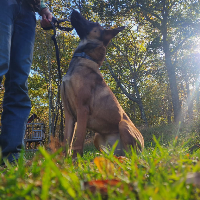
Scarlet is our rescue Belgian Malinois. She is beautiful, smart, sensitive, eager to work, and deeply bonded to us. She is also a poorly bred Malinois with an extremely intense prey drive. That combination matters. And it matters a lot.
The part people do not always want to hear. Scarlet is not safe with small animals. That is not dramatic. It is not an insult to her. It is simply the truth.
She has gotten ahold one of our cats badly enough that Bob had to physically intervene, and quite literally choke her to get her to release. It was terrifying. It was a moment that made very clear what we were dealing with, and it changed how we manage her forever.
That does not mean Scarlet is a bad dog. It means Scarlet is a Malinois with genetics, drive, poor breeding behind her, and instincts that can override everything else in the wrong moment.
She is eager to please. She wants to do the right thing. She does not like being in trouble. She is sensitive in the way many Malinois are sensitive. A harsh word can matter to her. Disappointing us matters to her. But drive is not the same thing as disobedience and genetics do not disappear because a dog loves you.
From herding dog to high-drive working dog
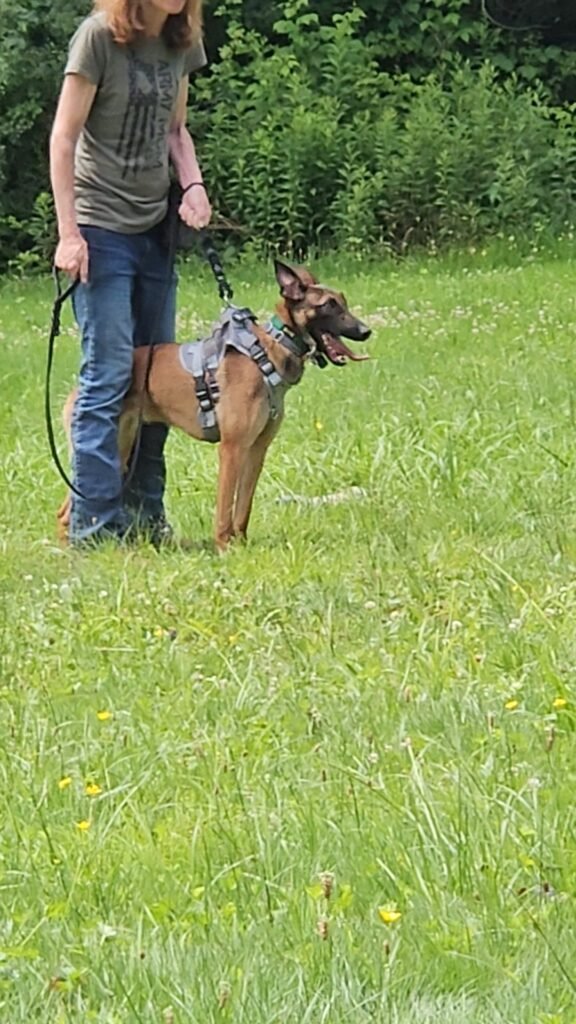
The Belgian Malinois has roots as a herding breed. Historically, these dogs were expected to work around livestock, move stock, take direction, and remain useful on farms.
That is an important part of the breed’s history. However, the modern Malinois many people know today, has also been shaped heavily by police work, military work, protection sports, and high-performance training. Over time, many breeding programs selected for speed, intensity, bite, athleticism, nerve, work ethic, and drive.
Those traits are impressive when they are properly channeled. They are also a lot to live with. A dog bred to notice movement, respond fast, chase hard, bite with commitment, and stay engaged under pressure is not automatically the best fit for a casual family homestead full of small animals.
That is not because the breed is “bad.” It is because purpose matters. A Malinois bred for serious work or sport may have instincts that look very different from the romantic idea of a farm dog calmly wandering among chickens and goats.
Homestead Goals
With Scarlet, our goal is not to make her friends with the cats, chickens, or goats. That may sound cold, but it is actually the safest and kindest approach for everyone involved.
We do not want her playing with the goats. We do not want her interacting with the chickens. We do not want her “getting used to” the cats by being allowed loose access to them.
Because with a dog like Scarlet, what looks like curiosity or play can turn into drive very quickly. A paw swipe, a chase, a squeal, a flap of wings, a running cat, a bouncing goat kid; any of those can flip a switch. Once that intensity takes over, the situation can become dangerous before a person has time to think.
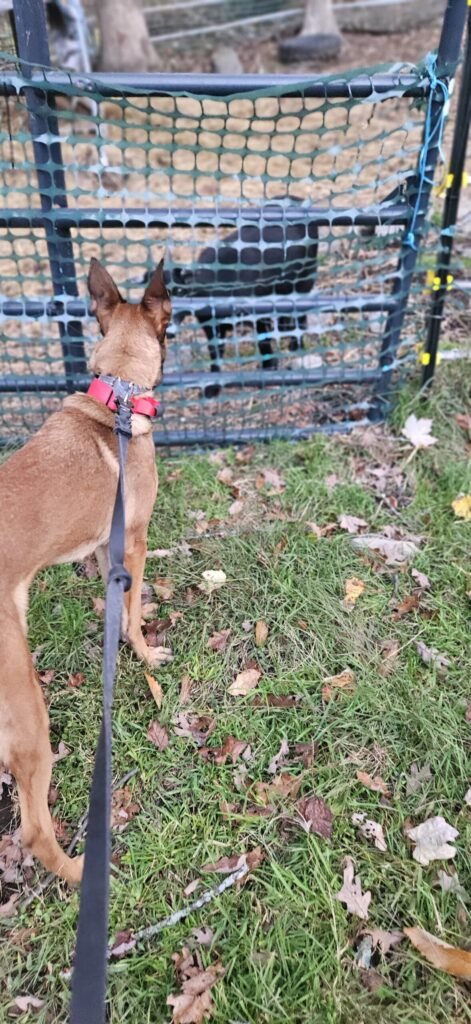
So our goal is simple:
Scarlet must ignore them. Not love them. Not mother them. Not herd them. Not play with them.
Ignore them. That is the standard.
Management is not failure. A lot of people want training to mean the dog is eventually “fixed.” With some dogs, that may be realistic. With Scarlet, as with many other high drive dogs, we do not pretend that is the case.
She can learn. She has learned. She responds beautifully to structure and consistency. She is easier to train in many ways because her drive is so strong. She wants the work. She wants direction. She wants to be right but she will never be a dog we fully trust loose around small animals or livestock. That is not a training failure. That is honest ownership.
Scarlet’s life requires management. Doors matter. Gates matter. Leashes matter. Timing matters. Awareness matters. We do not put her in situations where she is likely to fail, and we do not put our animals in situations where they pay the price for our wishful thinking.
Management Strategies
For the “Positive Reinforcement ONLY crowd” look away… We use an e-collar with Scarlet. **Gasp** Let’s be clear though, the e-collar is not a medieval torture tool and it is not because we want to punish her. We are not trying to make her afraid and it also isn’t because we believe tools replace training.
For Scarlet, the e-collar is primarily a way to interrupt intensity. Most often, that means vibration. It gives us a way to cut through the tunnel vision before she escalates. That is the key to management of these dogs, interruption before escalation.
In a true life-or-death situation, especially where the goats are concerned, stimulation is available as an emergency backup. That is not something we take lightly. But the reality is simple: if the choice is between a correction and a dead animal, we are going to protect the animal.
The tool is not the training plan. The training plan is structure, repetition, prevention, clarity, and consistency. The tool is there because we live in the real world, not a perfectly controlled training video.
Shaping Kairos and Unicorns
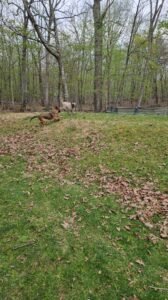
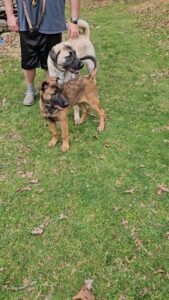
Kairos, our Malinois puppy, is already showing us that he is different from Scarlet. He may be different but we are not assuming anything. He is not as drivey. He is more of a follow-us-around puppy right now. He still shows interest in the goats and small animals, and we are addressing that immediately.
Not casually. Immediately. The time to build boundaries is before the behavior becomes a problem.
Our hope is that with strong genetics, early structure, and consistent training, Kairos may be able to exist on the homestead with less vigilance than Scarlet requires. Maybe. But we are not betting the cats, chickens, or goats on hope.
He is still a Malinois. He is still growing. His drives are still developing. What he is at this age may not be exactly what he becomes as an adult. So we train the dog in front of us and we respect the breed behind him.
Yes, there are unicorns. There are Malinois who live successfully with cats, chickens, goats, rabbits, and all kinds of small animals. They undeniably exist.
Some have lower prey drive. Some were raised carefully. Some have genetics that make that kind of life easier. Some truly are the exception but exceptions should not be treated as the rule. For every unicorn Malinois calmly ignoring chickens, there are many others who would see movement and want to chase, grab, control, or bite.
That does not make them broken. It makes them exactly what generations of breeding may have shaped them to be.
The hard truth about loving the breed
I love Scarlet with every ounce of my soul. She was never “meant” to be here but I am grateful that fate had other things in mind. However, I also deeply respect what she is capable of. Those two things have to exist together.
Loving a dog does not mean pretending their instincts are softer than they are. It does not mean ignoring warning signs because the dog is sweet with people. It does not mean assuming obedience in the kitchen will automatically hold up when a chicken runs, a goat jumps, or a cat bolts.
A Belgian Malinois can be an incredible dog. Incredible does equal being easy. Trainable does not mean safe in every situation. On a homestead, that distinction matters.
For us, responsible Malinois ownership means being honest. It means seeing Scarlet clearly. It means giving Kairos every chance to succeed without assuming he will be something he may not be. It means protecting our animals, protecting our dogs, and not letting fantasy override reality.
The Malinois is not just a smart dog. It is a purpose-bred dog. When you bring that kind of dog into a home full of small animals and livestock, you owe everyone involved more than good intentions.
You owe them truth, training, management, and respect for what genetics can do. That is the reality here and honestly, it is the only fair way to live with them.