Dogtra Pathfinder2 Review: Short Term Homestead Calibration Report
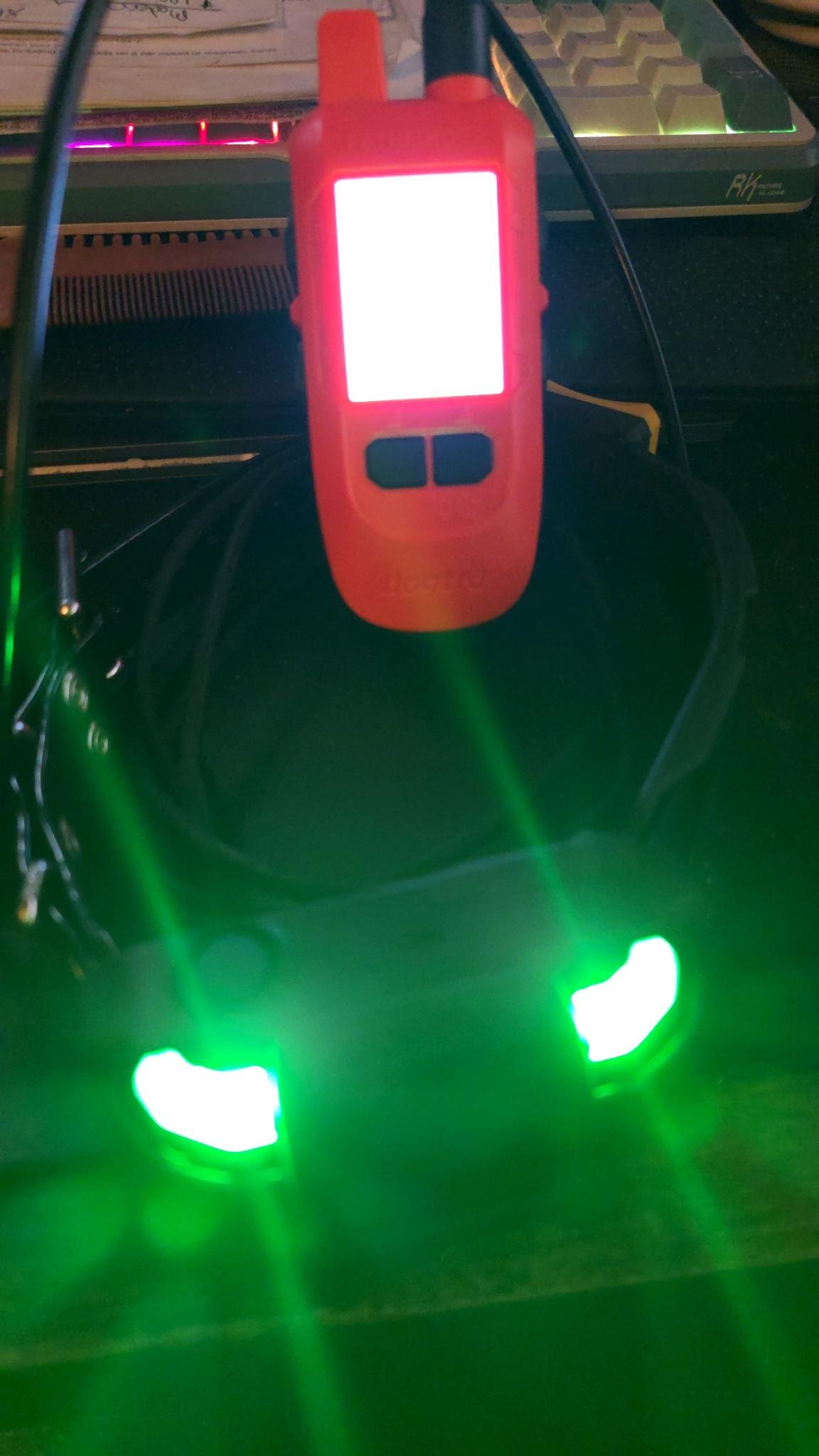
Bright green LED locator lights active on the Pathfinder 2 collar unit, custom configured directly through the smartphone application.
This is our Dogtra Pathfinder2 review, which we purchased for the explicit purpose of hiking with our dogs, allowing them to swim if they choose, and maintaining a reliable e-collar link for active field training. This is our short term, short use review on that system. If you don’t need or require the GPS functions, see our review of the Dogtra 1900X system on our “Gear Lab” page.
The total price we paid out of our own pocket was $917.40. That steep price tag included the COMPASS Handheld GPS Connector, two Pathfinder2 collars, and a set of one inch titanium contacts. Right out of the gate, Dogtra sent the wrong contacts for my specific unit. And just to be clear, I ordered these and paid for them with the initial system. You would think a major company would look at the system architecture purchased and ship the correct hardware configuration. Thanks for nothing, Dogtra. In their defense, I am currently awaiting approval for the return, but it is a frustrating hurdle when you expect a premium setup to work flawlessly out of the box.
Now, I know what you are thinking. Nearly a thousand dollars is a serious financial investment for the average person. Is there actual, real-world utility here to justify the cost? Let us break down the initial field data.
The Tactical Promise: A Zero Fee Dogtra Pathfinder2 Review
The absolute biggest selling point of the Pathfinder2 ecosystem is the lack of recurring overhead. Most high-end satellite tracking systems lock you into a predatory monthly data plan or an ongoing subscription grid just to access your own telemetry data. Dogtra gives you live GPS tracking for up to twenty-one dogs (with four visible on the screen simultaneously), offline mapping, rapid refresh rates, and completely customizable button configurations with zero extra fees.
The ability to track up to twenty-one dogs, or even use one handheld for twenty-one different assets, is a massive deal for logistics. Considering our household has four dogs that actively require a collar with GPS capability, finding a system that allows scaling without multiplying subscription fees is a core functional requirement.
On paper, the data points are impressive, at least to me: a nine mile tracking range, an IPX9K waterproof rating, a two second GPS refresh cycle, and rapid USB-C charging on the handheld only. But as a tester, my job isn’t to read the brochure; it is to find out where the engineering fails on the property line.
Short-Term Field Testing Logs
1. Hardware Pairing and App Initialization
The initial synchronization between the handheld transmitter and the individual collar receivers is remarkably simple. It is intuitive, quick, and required zero troubleshooting. The companion smartphone app is exceptionally robust, providing a clean satellite view of the property, custom naming protocols, independent intensity adjustments, and color-coded LED options for the collars. While I have not explored every dark corner of the software suite yet, the core mapping interface operates smoothly without lagging behind the dogs. However, I could do without Dogtra advertising other Dogtra products inside the software application. That is a distinct pet peeve of mine.
2. The GPS Translation Matrix
Because this system is heavily marketed toward hunters, the telemetry data screen uses specific operational shorthand like Treeing, Pointing, Running, or Hog. If you are not hunting game with your pack, you have to translate these alerts into practical homestead data. Per the manual and our short term testing, here is what those indicators actually mean in the yard:
- Bark: The asset is barking. No interpretation required.
- Pointing: The dog has ceased movement entirely. To the handler, this just means the dog is still.
- Treeing: The dog has placed two paws up on a vertical structure or tree trunk.
- Running: The dog is moving at a high velocity loop.
- Hog: Multiple dogs are actively barking within twenty meters of each other. Translation: something on the property line has the pack completely riled up and barking together.
3. Battery Depletion Metrics and Hidden Settings
Dogtra is surprisingly transparent with their baseline specs. They quote a strict two and a half hour limit for the battery life when the system is running heavy data loops. However, during our short term property tests, we found they are likely underselling their performance. We easily get four to ten hours of operational uptime on the collars because our dogs are not running miles away and we do not require constant, high frequency satellite updates.
There is a specific technical reason for this extended performance loop: both the handheld connector and the smartphone app feature a dedicated Battery Save Mode for the GPS collars. Turning this function on stops the collar from constantly transmitting heavy signal bursts when maximum precision tracking isn’t required. If you are managing your dogs inside a known boundary or working close by, this setting conserves the internal power cells significantly, so far.
The handheld connector itself boasts a much longer lifespan, easily lasting four to five days based on my usage (I turn off the handheld when in the house). The main reason I turn the handheld off when the dogs come inside is the acoustic volume: the transmitter loves to beep continuously whenever it assumes an asset is pointing or treeing. Hanging it up on the mudroom hook requires turning it off unless you want to listen to a persistent tracking alarm. Note: Sleep mode deactivates this constant beeping. You just need to remember to turn it on upon entering the house.
4. Raw Durability and Impacts
We truly cannot own nice things on this property. Both the handheld transmitter and the collar have already taken direct impact hits. I dropped the handheld from waist height directly onto a solid rock in the backyard, no less. It sustained a minor surface scuff but functions perfectly.
The collar was accidentally shoved off the truck tailgate by a dog exiting his travel crate, hitting the trailer hitch before slamming into the gravel. Aside from a cosmetic scuff, the electronics have shown zero degradation.
The Brutal Verdict: Dogtra Pathfinder2 Review Breakdown
The Good
- No Monthly Overhead: True standalone GPS telemetry with zero subscription dependencies. No having to hide Apple AirTags on collars just to track your assets.
- Built-In System Power Management: The Battery Save Mode inside the application and handheld menu successfully cuts down constant transmission loops, pushing the real-world collar lifespan far past the official two and a half hour brochure spec. I will be testing this in much more depth for the long term use review.
- Intuitive Vector Navigation: The built-in compass view gives an immediate line of sight direction to the dog, which is invaluable when an asset disappears behind dense brush or outbuildings.
- Honest Battery Telemetry: The manufacturer provides a realistic baseline that is easy to exceed during normal homestead management. However, during an active hunting trip where the system is constantly pinging at full power, this might not be as good.
The Bad
- Incompatible Hardware Shipments: Receiving incorrect titanium contact points, that I paid extra for, for a near thousand dollar system is poor quality control.
- Acoustic Alarm Friction: The constant beeping alerts for stationary behavior mean you are forced to power down the handheld the moment the dogs return to base, or not forget to put the system into Sleep Mode.
The Ugly
- The Missing Antenna Keepers: I absolutely despise the factory collar strap configuration. While I understand that waterproof PVC is mandatory for sweat, mud, and durability, not including simple antenna keepers on a system this expensive is terrible form. K9 handlers shouldn’t have to deal with a loose antenna wire flopping around or buy extra aftermarket accessories just to secure the hardware. This is especially true for hunting dogs that see some incredibly difficult terrain. It feels like a cheap attempt to milk every single dollar out of the consumer. That is a shame for a system as robust as this.
Operational Log: Yet to Evaluate
This is a short term calibration report. To maintain absolute honesty, we are reserving our final judgment on the following performance categories until we return from our upcoming wilderness hikes:
- Can the stimulation levels be customized on a per dog basis directly from the handheld unit without using the phone app?
- Will the waterproof seals hold up to prolonged, high-drive swimming?
- Does the lithium cell baseline degrade after continuous, long term charging cycles?
- Are replacement components and factory parts easily available when a failure inevitably occurs?
- How well does the Mobile Fence, Geo-Fence or E-Fence features work?
- What kind of battery life do you see with sleep mode used consistently?